The first thing that any new learning of Chinese has to understand and to master is the idea that the Chinese is a tonal language. Lemme explain what that actually means. Say these two sentences out loud: "What are you doing?" and "You're doing what?" Now did you notice a difference in how you pronounced the 'a' in 'what' ? This is a difference in tone. Chinese uses four different tones for each vowel and it completely changes the meaning of any pronounced word if you change the tone of the dominant vowel.
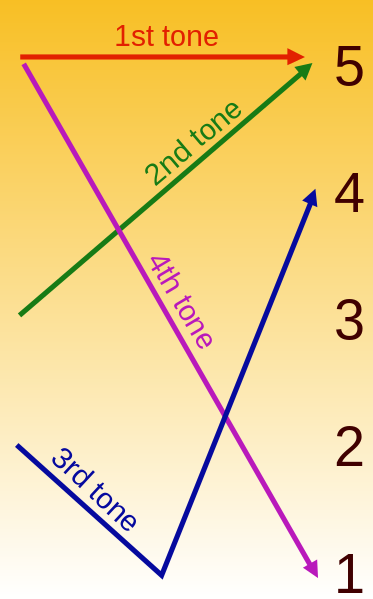
Romanized Chinese is written in a system called Pinyin. It uses our regular letting system with accent marks above vowels to tell which tones they are to be pronounced as. The vowels different tones are denoted as follows: ā, á, ǎ, à. They are called the first, second, third, and fourth tones, respectively. The way that you pronounce these can be difficult for new students to master, but like everything, you'll improve with practice.
Try to say these as described. The first tone is long and high pitched, as in the first 'what' sentence. The second starts low and rises. The third starts at a Medium tone, falls, then rises -above- where it started, as in the second 'what' sentence. And the third starts high and falls. This picture might help add some insight. In addition those for major tones, there is a 5th 'lack of tone' for letters. Many Chinese words will have more than one vowel, but always in succession. Only one of those vowels will be accented. The other is pronounced in the 5th tone - a very short, quick, unstressed tone most similar in nation to the first tone.
Now bear in mind that we have to do this with all the vowels: a i u o e. These aren't necessarily pronounced the same as in English either. 'A' is fairly close, think as in 'ahh' the sound you make at a doctors. 'I' is is more like how we say E. It is usually pronounced as 'eee' though sometimes changes to a more 'ehh' sound following another vowel. 'U' is said as 'oooo.' 'O' has more of an English 'a' or 'au' kind of sound. Much like the 'a' in 'ball' or 'baw' or 'jaw.' And finally 'e' is very different too. It sounds much more like an English 'u' in a lot of cases. It is pronounced 'uhh' such as in 'lung' or 'dung.'
Now practice those vowels! Say each one several times in each of the tones. Remember, practice makes perfect. I won't try to link you to a hundred different videos, but YouTube is a great place to look at for tone practice. There are a lot of different videos that will show you the tones for each letter and you can match your own efforts to meet their example. When you're done, come on back over here for grammar lessons!

No comments:
Post a Comment