Alright boys and girls, here comes the first juicy part. The first list of symbols!
你 nǐ you
好 hǎo good, okay
请 qǐng please (as in could you please...), to treat/invite someone
问 wèn to ask (a question)
贵 guì honorable, expensive
性 xìng one's last name (n)/ to be last named (v)
我 wǒ I, me
呢 ne particle for a tag question (to be explained)
小姐 xiǎo jiě Miss, young lady
叫 jiào to call, to be called
什么 shén me what (as in the question word)
名字 míng zi name
先生 xiān sheng Mr, husband
本有 Běn Yǒu Ben You, a proper name
王天 Wáng Tiān Wang Tian, another proper name
Now that we've finally gotten this list of vocab down, I expect it memorized by tomorrow! Make sure you write the symbols at least 20 times each or you can't ever hope for them to stick.
On a side note, the q's are pronounced as a 'ch' sound and the x's are a 'hsh' a very airy sound, almost like your normal 'sh' but with an added h sound, an expulsion of air, before it. Now get to memorizing!
Monday, February 14, 2011

Sunday, February 13, 2011
Lesson 0 - The Basics
The first thing that any new learning of Chinese has to understand and to master is the idea that the Chinese is a tonal language. Lemme explain what that actually means. Say these two sentences out loud: "What are you doing?" and "You're doing what?" Now did you notice a difference in how you pronounced the 'a' in 'what' ? This is a difference in tone. Chinese uses four different tones for each vowel and it completely changes the meaning of any pronounced word if you change the tone of the dominant vowel.
Romanized Chinese is written in a system called Pinyin. It uses our regular letting system with accent marks above vowels to tell which tones they are to be pronounced as. The vowels different tones are denoted as follows: ā, á, ǎ, à. They are called the first, second, third, and fourth tones, respectively. The way that you pronounce these can be difficult for new students to master, but like everything, you'll improve with practice.
Try to say these as described. The first tone is long and high pitched, as in the first 'what' sentence. The second starts low and rises. The third starts at a Medium tone, falls, then rises -above- where it started, as in the second 'what' sentence. And the third starts high and falls. This picture might help add some insight. In addition those for major tones, there is a 5th 'lack of tone' for letters. Many Chinese words will have more than one vowel, but always in succession. Only one of those vowels will be accented. The other is pronounced in the 5th tone - a very short, quick, unstressed tone most similar in nation to the first tone.
Now bear in mind that we have to do this with all the vowels: a i u o e. These aren't necessarily pronounced the same as in English either. 'A' is fairly close, think as in 'ahh' the sound you make at a doctors. 'I' is is more like how we say E. It is usually pronounced as 'eee' though sometimes changes to a more 'ehh' sound following another vowel. 'U' is said as 'oooo.' 'O' has more of an English 'a' or 'au' kind of sound. Much like the 'a' in 'ball' or 'baw' or 'jaw.' And finally 'e' is very different too. It sounds much more like an English 'u' in a lot of cases. It is pronounced 'uhh' such as in 'lung' or 'dung.'
Now practice those vowels! Say each one several times in each of the tones. Remember, practice makes perfect. I won't try to link you to a hundred different videos, but YouTube is a great place to look at for tone practice. There are a lot of different videos that will show you the tones for each letter and you can match your own efforts to meet their example. When you're done, come on back over here for grammar lessons!
Romanized Chinese is written in a system called Pinyin. It uses our regular letting system with accent marks above vowels to tell which tones they are to be pronounced as. The vowels different tones are denoted as follows: ā, á, ǎ, à. They are called the first, second, third, and fourth tones, respectively. The way that you pronounce these can be difficult for new students to master, but like everything, you'll improve with practice.
Try to say these as described. The first tone is long and high pitched, as in the first 'what' sentence. The second starts low and rises. The third starts at a Medium tone, falls, then rises -above- where it started, as in the second 'what' sentence. And the third starts high and falls. This picture might help add some insight. In addition those for major tones, there is a 5th 'lack of tone' for letters. Many Chinese words will have more than one vowel, but always in succession. Only one of those vowels will be accented. The other is pronounced in the 5th tone - a very short, quick, unstressed tone most similar in nation to the first tone.
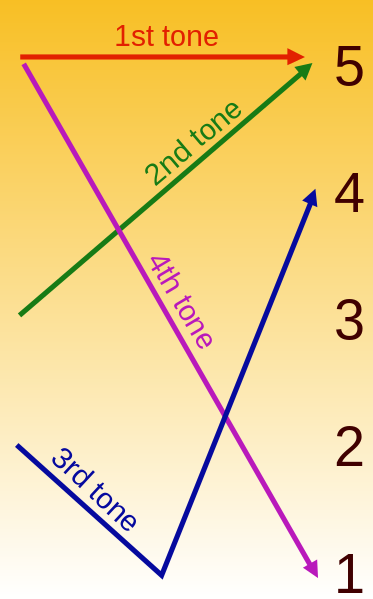
Now bear in mind that we have to do this with all the vowels: a i u o e. These aren't necessarily pronounced the same as in English either. 'A' is fairly close, think as in 'ahh' the sound you make at a doctors. 'I' is is more like how we say E. It is usually pronounced as 'eee' though sometimes changes to a more 'ehh' sound following another vowel. 'U' is said as 'oooo.' 'O' has more of an English 'a' or 'au' kind of sound. Much like the 'a' in 'ball' or 'baw' or 'jaw.' And finally 'e' is very different too. It sounds much more like an English 'u' in a lot of cases. It is pronounced 'uhh' such as in 'lung' or 'dung.'
Now practice those vowels! Say each one several times in each of the tones. Remember, practice makes perfect. I won't try to link you to a hundred different videos, but YouTube is a great place to look at for tone practice. There are a lot of different videos that will show you the tones for each letter and you can match your own efforts to meet their example. When you're done, come on back over here for grammar lessons!
Saturday, February 12, 2011
Introduction
Hello everyone! This is a blog dedicated to all those individuals out there that are interested in learning some Mandarin Chinese. Whether you're a business executive looking to know some travel phrases or a serious potential student that wants to become fluent, this is a great place to start!
Years ago I , a fresh face to the new internet, was trying to find any kind of helpful website to start me off learning Chinese. Unfortunately, there were almost no resources at all! And even more strikingly, that hasn't changed since that time. Instead, over the last three years I've been spending my time studying the wonderful Chinese language at a University level. Now I hope to give back to the internet community and help anyone passionate about learning this amazing foreign language, but without access to any free resources.
If you are interested in learning Mandarin Chinese, then keep following this blog!
Years ago I , a fresh face to the new internet, was trying to find any kind of helpful website to start me off learning Chinese. Unfortunately, there were almost no resources at all! And even more strikingly, that hasn't changed since that time. Instead, over the last three years I've been spending my time studying the wonderful Chinese language at a University level. Now I hope to give back to the internet community and help anyone passionate about learning this amazing foreign language, but without access to any free resources.
If you are interested in learning Mandarin Chinese, then keep following this blog!
Subscribe to:
Posts (Atom)